Blog

7 Best Heavy Duty Racking Systems for Global Buyers?

Choosing a heavy duty racking system is not just a matter of comparing steel frames. It is about matching storage design to pallet dimensions, handling equipment, inventory turnover, and the building itself. W. Edwards Deming, a quality-management expert, is widely credited with the reminder, “Quality is everyone’s responsibility.” For warehouse buyers, that principle means involving operations and safety teams—not just purchasing—before approving a layout.

Small details matter. A forklift turning beside a loaded aisle needs room; an uneven floor can affect installation; and a beam level must suit the actual pallet load. This guide compares seven options: selective pallet, double-deep, drive-in, push-back, pallet-flow, cantilever, and mobile racking. Each serves different storage and access needs. Higher density can reduce aisle space, but it may also limit access to individual pallets. There is no universal winner.

The comparison focuses on practical selection factors, including accessibility, storage density, product suitability, and operating constraints. Buyers should verify load ratings and request a layout review from a qualified racking professional before installation. A product page cannot assess every site condition. This guide is a useful starting point, not an engineering sign-off—and that distinction is easy to overlook.
7 Best Heavy Duty Racking Systems for Global Buyers?

What Defines a Heavy-Duty Racking System?

A heavy-duty racking system is defined by its verified load capacity, structural design, and fit with the loads it will actually carry—not by thick-looking steel. There is no single universal capacity threshold for the term. The Rack Manufacturers Institute’s ANSI MH16.1-2023 standard sets engineering requirements for industrial steel storage racks, including frame and beam design. A proper specification states the allowable load per beam level and per upright frame.

Numbers matter. For example, four pallets weighing 2,000 pounds each create an 8,000-pound level load, before considering uneven placement or handling impacts. The beam pair, uprights, floor slab, anchors, and connections must all support the intended configuration. One weak link changes the rating. Ask for load plaques, design documents, and clear limits for pallet size and placement.

Conditions on site matter too. OSHA’s 29 CFR 1910.176(b) requires stored materials to be stable and secured against sliding or collapse. That is a practical benchmark, not a rack-capacity formula. Inspect for bent uprights, loose anchors, and damaged beam connectors; small distortions can be easy to overlook. A rack can be engineered well and still be poorly suited to a facility’s forklifts, aisle widths, or changing inventory. That deserves a second look.

Seven Heavy-Duty Racking Systems Used in Global Warehouses

Heavy-duty racking is a warehouse design choice, not a one-size-fits-all purchase. Seven systems serve different inventory patterns: selective pallet racks offer direct access to each load; double-deep racks trade some access for greater density. Drive-in and drive-through racks suit deep storage of similar products, while push-back racks allow several pallets per lane. Pallet-flow racks move cartons or pallets by gravity. Cantilever racks hold long items such as pipes and timber. High-bay automated storage systems combine tall structures with retrieval equipment.

The right fit depends on pallet weight, load dimensions, handling equipment, turnover, and available floor space. Space is tight. Dense layouts can reduce access and make picking less flexible. In the Material Handling Industry’s 2024 Annual Industry Report, 55% of surveyed supply-chain professionals said they planned to increase technology investment within two years. That signals growing interest in automation, but it does not make automated storage suitable for every warehouse.

Compare usable capacity, access needs, installation conditions, and future changes before choosing. Check rack loading information against actual pallet weights, and plan for inspections and damage reporting. A small layout detail matters: aisle width must match the equipment that will travel through it. Early estimates can be wrong; test the proposed layout with real load dimensions and operating routines before committing.

7 Best Heavy-Duty Racking Systems for Global Buyers

Seven heavy-duty racking systems used in global warehouses

The chart compares typical system characteristics on a relative 1–5 scale, not measured capacity or a universal industry benchmark. Selective racks offer direct access to each pallet; dense systems such as drive-in and mobile racking prioritize floor-space use, with access depending on the layout and operating method. Actual performance varies with warehouse design, pallet dimensions, equipment, and safety requirements.

How Rack Types Differ in Capacity, Access, and Storage Density

7 Best Heavy Duty Racking Systems for Global Buyers?

How Rack Types Differ in Capacity, Access, and Storage Density

Heavy-duty racking is not one-size-fits-all. Selective pallet racks provide direct access to every pallet, making them practical for varied stock and frequent picking. Drive-in racks store pallets several positions deep, improving density but limiting access to older stock. Push-back systems offer a middle ground: pallets move forward as loads are removed. Capacity depends on rack design, pallet dimensions, floor conditions, and loading practices. Confirm rated loads with a qualified supplier before installation.

Pallet flow racks use gravity rollers to move stock toward the picking face, which can support first-in, first-out rotation. Cantilever racks suit long items such as pipes or timber, while mobile racks reduce aisle space by moving along floor rails. Mezzanine platforms add usable storage levels, but require careful checks for floor loading, access, and safe movement. More density is not always better. A narrow aisle may slow picking or complicate equipment access.

Tips: Measure actual pallets, including overhang. Map turning space for forklifts. Keep load signs visible, and inspect beams and connectors for damage. Small details matter. A layout that looks efficient on paper may need adjustment once workers handle real orders. Recheck the plan as inventory and picking patterns change.

Safety, Standards, and Installation Considerations Across Markets

Heavy-duty racking safety starts with the building, not the beam. A qualified engineer should check floor capacity, slab condition, seismic exposure, and the loads each bay will carry. Requirements vary by market: EN 15635 addresses the use and maintenance of steel static storage systems, while ANSI MH16.1 covers industrial steel storage rack design and testing in the United States. Neither replaces local building and fire-code review.

HSE’s 2023/24 workplace statistics estimated 604,000 non-fatal workplace injuries in Great Britain. That figure covers all industries, not racking incidents, but it shows why practical safeguards matter. Small details matter. Installers should verify upright plumb, beam locks, anchors, and specified clearances against approved drawings. A level floor can still conceal weak concrete. Record deviations before loading, and post clear capacity signs where operators can see them.

After handover, inspect for bent uprights, loose components, impact damage, and overloaded beams. Set inspection intervals according to use, risk, and applicable guidance; busy forklift aisles may need closer attention. Keep inspection records and isolate damaged bays until a competent person assesses them. One awkward point: paperwork cannot prevent a rushed driver from clipping a frame. Physical aisle protection and operator training deserve equal attention.

7 Best Heavy Duty Racking Systems for Global Buyers: Safety, Standards, and Installation Considerations Across Markets

Racking system Best suited for Access and stock rotation Key advantages Important limitations Safety and installation considerations
Selective pallet racking Warehouses needing direct access to a wide range of palletized products. Each pallet position is generally accessible from the aisle; supports FIFO or LIFO inventory control. Flexible layout, straightforward stock picking, and easy access for common forklift types. Requires more aisle space than high-density systems, so storage density may be lower. Specify frame, beam, bracing, anchors, and floor slab for the actual loads and site conditions. Set beam levels and clearances to suit pallets and handling equipment; protect exposed uprights where impact risk exists.
Double-deep pallet racking Operations seeking higher storage density while retaining access to individual lanes. Pallets are stored two positions deep; the rear pallet is less accessible and usually needs a suitable reach truck or attachment. Reduces the number of aisles compared with a similar selective layout. Some pallets require another pallet to be moved first; the system can reduce selectivity and may require specialized equipment. Confirm forklift reach, lift height, load handling, aisle width, and visibility before layout approval. Design for the actual beam loads and pallet arrangement, and train operators on rear-position handling.
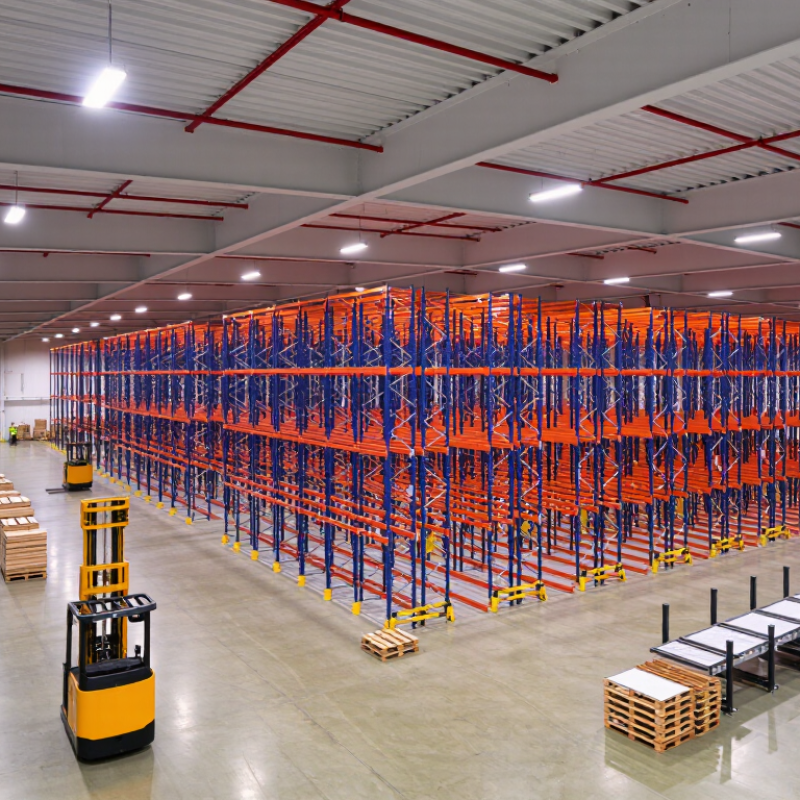
Drive-in and drive-through racking Large quantities of similar products stored in deep lanes. Drive-in commonly uses LIFO access from one end. Drive-through can support FIFO when loading and retrieval occur at opposite ends. High storage density because fewer access aisles are required. Lower selectivity than selective racking; forklifts enter the rack structure, increasing the importance of careful operation. Verify truck dimensions, lane depth, pallet condition, and operating clearances. Install and maintain entry guides and column protection where appropriate; keep rack components and floor surfaces clear of obstructions.
Push-back racking Medium- to high-volume storage with multiple pallets of each product per lane. Typically LIFO: loading pushes existing pallets back along inclined carts, and retrieval removes the front pallet. Provides higher density than selective racking while allowing forklift access from the aisle. Not generally suitable when strict FIFO is required; pallets must be compatible with the cart and lane design. Confirm pallet dimensions, weight distribution, and load compatibility with the engineered carts. Train operators in loading and retrieval sequence, and inspect carts, rails, stops, and lanes according to the maintenance plan.
Pallet flow racking High-throughput operations with repeat products and a need for orderly stock rotation. Usually FIFO: pallets enter at the loading end and move by gravity toward the retrieval end on rollers or wheels. Separates loading and retrieval faces and can support dense, fast-moving storage. Requires suitable pallets and careful control of lane loading; roller tracks and brakes need maintenance. Have the flow lanes engineered for the pallet, load, and operating conditions. Follow the specified loading sequence and inspect rollers, speed controllers, end stops, and safety separators regularly.
Cantilever racking Long, bulky, or irregular goods such as pipe, timber, sheet materials, and structural sections. Products are usually stored on arms and accessed from the aisle; stock rotation depends on the handling process. Open-front design accommodates long loads without front uprights obstructing access. Load stability and arm loading can be sensitive to product length, overhang, and uneven weight distribution. Specify arm, column, and base loads for the actual goods and support spacing. Confirm the required arm orientation, bracing, floor anchorage, and handling-equipment clearances; secure products against rolling or shifting where needed.
Mobile pallet racking Facilities where floor area is limited and selected aisles can be opened as needed. Rack rows move on powered or manually operated mobile bases to create an access aisle at the required location. Can increase storage density by reducing the number of permanently open aisles. Access is not simultaneous at every row; moving equipment, controls, and operating procedures add complexity. Coordinate rack design with the floor slab, rails or guidance system, electrical supply, and building layout. Install and test access controls, emergency stops, and aisle-safety features; keep the operating zone clear and follow the system-specific procedures.

Standards and project note: Applicable requirements vary by country, building code, seismic conditions, and facility use. In the United States, industrial steel storage rack design and use commonly refer to ANSI MH16.1 and applicable workplace rules, including OSHA 29 CFR 1910.176(b) for secure storage of materials. European projects commonly use the relevant EN 15512, EN 15620, EN 15629, and EN 15635 standards. Australian projects should check the applicable provisions of AS 4084. A qualified local engineer should verify the governing requirements, rack configuration, floor capacity, anchorage, seismic design, load signage, and installation before use. Rated capacities are specific to the engineered design and must not be inferred from a generic system description.

How Global Buyers Can Compare Systems and Select the Right One

Global buyers should compare heavy-duty racking by pallet dimensions, load weight, SKU count, and replenishment pattern—not headline capacity alone. Selective racks give direct access to every pallet, while drive-in systems trade access for dense storage. Push-back and pallet-flow layouts can speed rotation, but need compatible pallet quality and careful aisle planning. Measure the actual loads. Include pallet overhang, beam deflection limits, forklift turning radius, and floor condition in the quotation review. A clear drawing often catches conflicts before shipment.

Cross-border projects also need comparable engineering documents, since load ratings may use different units and assumptions. MHI’s 2024 Annual Industry Report, drawing on nearly 1,000 supply-chain professionals, found that 55% planned to increase supply-chain technology investment. Use that signal to check whether rack labels, inspection records, and warehouse software share reliable load data. It does not prove one rack type is best. Ask suppliers for engineer-reviewed calculations, installation tolerances, corrosion protection details, and replacement-part dimensions. Verify seismic assumptions and local engineering requirements with a qualified engineer. Small omissions matter. A missing clearance can turn a good plan into daily forklift work. Still, spreadsheets miss awkward pallets and rushed replenishment.